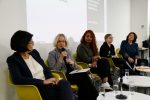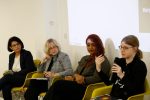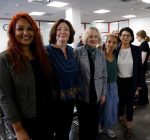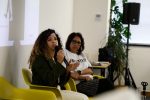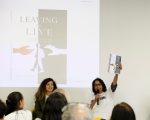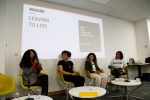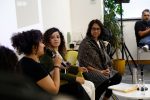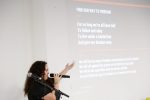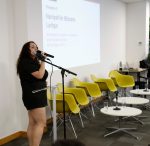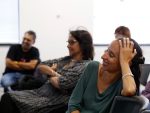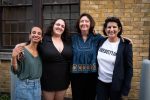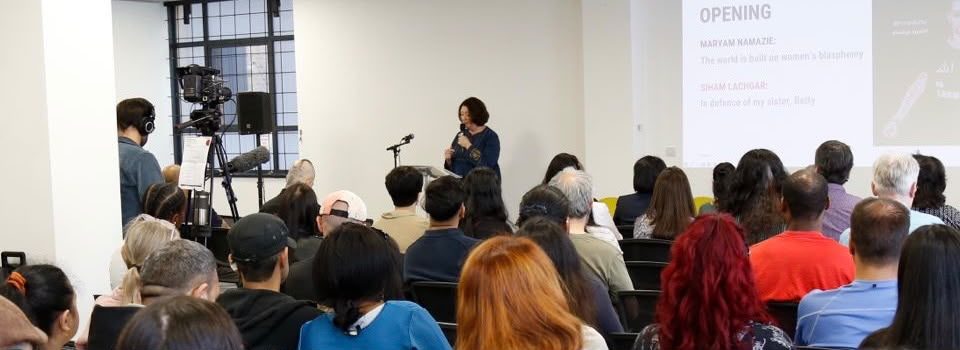
On 26 September 2026, the sold-out Leaving to Live: Women’s Blasphemy, Apostasy and Freedom conference brought together feminists, ex-Muslims, lawyers, secularists, artists, campaigners and people with direct experience of leaving Islam for a day-long gathering in London.
MCed by Fariborz Pooya and Haram Doodles, the conference addressed the many ways women pay a price for questioning, leaving or challenging religion, through state repression, imprisonment, threats, family and community coercion, asylum and migration, concealment, isolation and the long process of rebuilding a life on one’s own terms.
The conference was united by a central question: who gets to decide the terms on which we live? Betty Lachgar’s imprisonment in Morocco, the experiences of women living as closeted ex-Muslims in Britain, the difficulties apostates can face in the asylum system and the psychological consequences of leaving high-control religious environments were not treated as separate issues but different manifestations of the same struggle over who has authority over women’s beliefs, bodies, relationships and lives.
At the centre of the conference was the case of Moroccan feminist and rights activist Ibtissame Betty Lachgar, imprisoned in Morocco since 10 August 2025. Betty’s sister, Siham Lachgar, opened the conference by speaking of her “sister in blood and in struggle” and of Betty’s long history of feminist and civil-disobedience activism. She described both Betty’s deteriorating health in prison and her continued solidarity with other women there. In words relayed from prison, Betty said that although detained she remained “revolutionarily free” and faithful to her feminist principles.
Betty’s lawyer, Ghizlane Mamouni, then gave a detailed account of her case, the application of Article 267-5 of the Moroccan Penal Code and the grave danger to Betty’s health. Mamouni told the conference that what was happening to Betty was “not only her story” but “a warning to all of us,” and asked the question increasingly heard by activists in Morocco: “Who will be next?” She described the deterioration of Betty’s prosthesis, the repeated rejection of requests for medical release and the wider chilling effect of repression on activists, artists and others who speak publicly.
Betty’s case showed in its starkest form what can happen when religious authority is backed by state power. But the conference repeatedly returned to the fact that coercion does not begin or end with the state. It can also operate through family, community, social isolation, threats, shunning, economic dependence and the fear of losing everything that makes ordinary life possible.
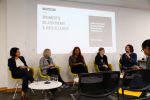
The first panel, on Women’s Blasphemy and Resistance, brought Mamouni together with Annie Laurie Gaylor, co-president of the Freedom From Religion Foundation, artist and ex-Muslim activist Haram Doodles and Head of Campaigns at the National Secular Society Megan Manson. Gaylor spoke about FFRF’s support for Betty and the decision to award her the 2026 Avijit Roy Courage Award, established with Bonya Ahmed in memory of the Bangladeshi-American atheist writer murdered in Dhaka in 2015.
The discussion considered blasphemy, secularism, freedom of religion or belief, the political power of religious-right movements and the particular consequences for women who challenge sacred authority. It also addressed the false opposition between defending minorities from racism and defending women, atheists, ex-Muslims and dissenters from religious fundamentalism.
Manson stressed that freedom of religion or belief necessarily includes the freedom not to be religious and the freedom to criticise religion. She argued that secularism is essential precisely because it protects both religious and non-religious people from the imposition of belief through the state.
Haram Doodles spoke about art, visibility and the importance of ex-Muslims being able to tell their own stories. The discussion emphasised that leaving Islam is often about much more than changing one’s mind about belief: it can raise questions about authority over women’s bodies, sexuality, clothing, relationships, mobility and futures.
The conference also screened a Human Rights Tattoo film on Betty and an extract from Inna Shevchenko’s Gods and Girls, bringing film and art into the wider discussion about women confronting religion, patriarchy and political power.
A new song for Betty, Hurriyah (Freedom), produced by singer-songwriter Shelley Segal and SA’s Simhala Foundation with Motown legend Lee Garrett and Betty Lachgar, was premiered during the conference. Participants also took part in filming for the music video during the break.
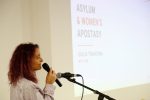
The same questions of freedom, coercion and consequences continued throughout the afternoon. Giulia Tranchina, Senior Associate Solicitor at Wilson Solicitors LLP, spoke on asylum and women’s apostasy, drawing on her experience representing refugees, apostates, political activists and LGBTQ+ people. Her contribution examined what happens when questioning or leaving religion makes it impossible for someone to live safely in their country of origin, and when the right to disbelieve becomes inseparable from the right to seek asylum.
The conference also paid tribute to the late Marieme Hélie-Lucas, the Algerian feminist, internationalist and founder of Women Living Under Muslim Laws who later co-founded Secularism Is A Women’s Issue. In a tribute delivered by video, feminist and human rights activist Yasmin Rehman reflected on Hélie-Lucas’s insistence that women’s rights could not be subordinated either to religious fundamentalism or to communal and identity politics.
The tribute recalled Hélie-Lucas’s insistence that it must be possible to oppose racism and religious fundamentalism at the same time; to defend minorities from hatred without handing religious or community leaders ownership over the women within those minorities; and to defend a woman’s right to practise her religion while defending just as fiercely another woman’s right to leave it.
Writer, journalist and feminist activist Rahila Gupta, a trustee of Southall Black Sisters, then spoke with counselling psychologist Savin Bapir-Tardy about Leaving to Live: A Psychoeducational Guide for Ex-Muslims. Their discussion explored the process of rebuilding identity, safety, trust and relationships after leaving a high-control religious environment. As the session introduction put it, leaving Islam is “not necessarily the end of the story.” For many people, it is the beginning of working out who they are without beliefs, rules and identities that previously shaped their lives. As Bapir-Tardy stressed, “There is no such thing as a successful recovery or a linear process.”
That discussion continued in the final panel, chaired by Gupta, with Daisy, Esme, Lamah Al Saif and Bapir-Tardy. The panel brought lived experience directly into the discussion.
Saudi-born ex-Shia Muslim activist Lamah Al Saif described coming to the UK as an asylum seeker as an ex-Muslim and queer woman, and spoke of actively seeking out ex-Muslim support groups because of the loneliness she experienced. “I feel the most comfortable joining the women’s support group because our issues — we can relate more to each other… the shame that was instilled in us women is far beyond anything that I think a Muslim man or an ex-Muslim man would ever think about.” Esme similarly spoke of the importance of finding support after years of navigating life as an ex-Muslim and ex-hijabi. “When you tell somebody that you are an ex-Muslim, they think you just decided one day. It was years and years and years of questioning and going back and forth,” she said.
A statement from Daisy, who could not speak publicly under her own identity, was read to the conference. She described remaining closeted about her disbelief because she fears her child could be used to pressure her back into Islam and damage their relationship. “I am closeted about my disbelief. Nobody in my life knows,” she said.
These experiences placed Betty’s case within a wider continuum rather than in a separate category. Betty faces prison and the possibility of devastating consequences for her health. Other women may face shunning, surveillance, family rejection, loss of housing or financial support, forced dependence, threats, concealment or the possibility of having their children or relationships used against them.
These are also central themes of Leaving to Live: A Psychoeducational Guide for Ex-Muslims, which has now been published by the Council of Ex-Muslims of Britain. Written by Savin Bapir-Tardy, the book draws on CEMB support groups, clinical work and psychological research. It addresses coercive control, concealment, shunning, shame, fear, sexuality, bodily autonomy and identity, before turning to practical questions of safety, self-trust, boundaries, grief, relationships and rebuilding a life shaped by personal choice. CEMB runs several monthly groups led by Bapir-Tardy, including mixed, women’s, psychoeducation and pre-joining sessions, providing regular spaces for ex-Muslims to access support, share experiences and rebuild their lives.
The book does not assume one ex-Muslim experience or present public disclosure as the measure of freedom. It explicitly recognises that some people leave openly while others must remain closeted for reasons of housing, finances, immigration status, family relationships, physical safety or access to their children. Its central concern is whether people are genuinely free to question, disagree and leave without serious consequences. That distinction was fundamental to the conference.
Some women resist publicly, as Betty Lachgar has done, confronting religious authority through civil disobedience. Others resist privately, sometimes saying nothing because disclosure would put their safety, children, housing or relationships at risk.
As Maryam Namazie, spokesperson for the Council of Ex-Muslims of Britain, said in her opening remarks, Betty may be imprisoned by the Moroccan state while another woman sitting in London may be imprisoned by her family. “They are not the same, of course,” she said, “but both enforce the same system of control, teaching the same lesson: If you leave, if you speak up, you will pay.”
That is also why public apostasy and blasphemy matter. As Namazie argued, “Apostasy makes hidden dissent visible. Blasphemy makes sacred authority contestable.”
The conference ended with Shelley Segal’s Find Our Way to Freedom.
As CEMB approaches its twentieth anniversary in June 2027, the closing message was that the need for ex-Muslims to organise, support one another and speak publicly has not disappeared. The movement has grown precisely because people who were once told they did not exist have made themselves visible.
As Namazie said in closing, despite the difficulties, Cwe are fighting back. We are demanding our right to live and love and think the way that we want.”
Leaving to Live made clear that the right to leave religion cannot be reduced to the private freedom to stop believing. It must also mean the right to live after leaving: without imprisonment, coercion, forced silence, shunning or fear, and with the freedom to build a life on one’s own terms.
That is the freedom at the heart of the struggle for Betty, for ex-Muslims and for all those who refuse to let religion, the state, family or community decide the terms on which they live.
The conference was supported by Awards for All, the National Secular Society and the Freedom From Religion Foundation.
Support our work
As CEMB approaches its 20th anniversary, we are raising funds for our Celebrating Dissent conference in London on 19 June 2027, marking twenty years of organising for the right to leave religion and live freely. Donations will also help us put printed copies of Leaving to Live into the hands of people attending our support groups and enable us to continue our support, campaigning and public activities.
Please donate and help us continue this work.
NOTES:
1. Videos of the conference can be viewed here:
2. Leaving to Live: A Psychoeducational Guide for Ex-Muslims is available free of charge on our website. It can be purchased for £19.99 plus shipping by contacting exmuslimcouncil@gmail.com.
3. Conference schedule and speaker biographies can be found here.
4. Related events and support: CEMB runs several online support groups each month, including mixed, women’s, psychoeducation and pre-joining sessions led by Savin Bapir-Tardy. Upcoming sessions can be found on our events page. Girls and Gods by Inna Shevchenko will also be screened at the Austrian Cultural Forum London on Thursday 5 November 2026, followed by a Q&A with Inna Shevchenko and Maryam Namazie.
5. Photos from event: